


Canine hydrotherapy
Hydrotherapy is an essential part of a dogs rehabilitation journey. it provides a weightless environment, assists with gait re-education and increases muscular strength and cardiovascular fitness.
Nicole has completed her Level 4 canine hydrotherapy and advanced treadmill techniques training at Greyfriars Veterinary Rehabilitation and Hydrotherapy Referrals and currently works at Therapaws Canine Rehabilitation Centre as a hydrotherapist and physiotherapist since 2023.

Post-operative and conservative treatment
Hydrotherapy can assist with the rehabilitation of both orthopaedic and neurological conditions following surgery as well as a form of conservative management to assist recovery, restore normal function, strengthen supportive musculature and improve quality of life.

Weight loss management
Hydrotherapy can become part of your dogs weight loss programme due to the increased muscular and cardiovascular effort required during swimming, whilst providing a weight-less environment. This is particularly important for dog with with arthritis as a form of low-impact exercise.
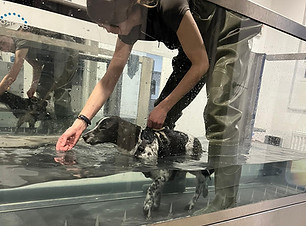
Fitness and conditioning
Advanced hydrotherapy can be utilised as part of a fitness programme for working dogs including policing dogs, herding dogs, agility dogs and flyball dogs to strengthen musculature, improve balance and stability, reduce the risk of injury and as a result, improve performance.
Bouyancy
Buoyancy is the upwards thrust exerted by the water, opposite to gravity. This helps to reduce the loading of the joints, reduces the level of weight bearing and decreases the vertical ground reaction forces which has been found to decrease by 62% when immersed in water to the level of the hip joint. This then improves ambulation and spinal posture, encourages active use of the joints and greater range of motion without putting the joint under strain.
Hydrostatic pressure
Hydrostatic pressure is the pressure exerted by the water onto the body, this increases as you immerse deeper into the water. This helps to decreases oedema and swelling, increases circulation and venous return, increases lymphatic circulation and increases sensory stimulation which decreases nociceptive hypersensitivity by blocking pain signals through the pain gate theory.
Viscosity
Viscosity is defined as ‘the state of being thick, sticky, and semi-fluid in consistency, due to internal friction’. The viscosity of water is higher than that of air, increasing the resistance within the water and requires greater exertion than on land, increasing muscle strength and cardiovascular fitness. It also increases stability of the joints, sensory perception and therefore improving proprioception, balance and confidence. Particularly important for neurological patients or post-operative patients where proprioception is impaired (due to the invasive nature of the surgical procedure and as well as secondary muscle weakness / atrophy).
Temperature
Temperature of the pool water is generally set between 28-30 degrees. This provides a warm and comforting environment for the dog, helping to relieve muscle spasm and decrease pain through the stimulation of sensory fibres inhibiting the transmission of pain signals. This improves the dogs mental wellbeing as well as helping them feel more comfortable in the water allowing a greater range of motion and fluidity of movement.